
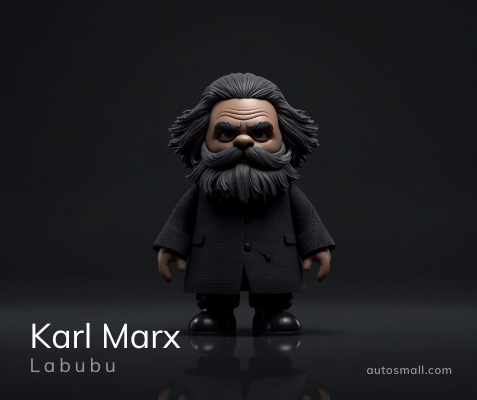
The tiny, fanged, oddly loveable Labubu sits on millions of shelves worldwide, and somehow, it has become one of the most talked-about objects of the 21st century. People unbox it, photograph it, and post it — yet almost nobody actually uses it for anything. This strange reality pulled me into a rabbit hole of philosophy, and the further I went, the more I kept arriving at one name: Karl Marx. What started as a curiosity about a designer toy quickly became a lens through which I began reading the entire cultural mood of Generation Z and Generation Alpha — a mood the internet has lazily labelled Brain Rot, but which deserves far more serious examination.
Brain Rot Is Not Stupidity — It Is a Coping Mechanism
Most people hear Brain Rot and immediately picture teenagers watching pointless videos at 2am. I used to think the same thing — until I started paying closer attention to why those videos exist and why they spread so fast. The complex geopolitical and social landscape of today has placed an unbearable weight on young people. Endless conflict and wars, collapsing democracies, and the looming threat of systemic scandals have made the real world feel genuinely unliveable for millions of young minds. Rather than breaking under that pressure, Gen Z and Gen Alpha discovered an exit door — hyperactive, nonsensical, and absurd humour — and they walked straight through it. Brain Rot, understood properly, is not a sign of intellectual failure but a fully rational psycho-social response to a world that offers no easy answers.
Cognitive Dissonance and the Subject Generation
Leon Festinger’s theory of Cognitive Dissonance describes the internal stress a person feels when their beliefs and their actions pull in opposite directions. Young people today live inside this tension every single day. They know the global system runs on moral and ecological bankruptcy — fast fashion destroys the planet, corporations exploit workers, and political promises dissolve on contact with reality — yet they still clock in, scroll on, and consume because survival inside the system demands participation. Festinger called this gap a source of acute psychological stress, and in the case of the Subject Generation, that stress has become a permanent background noise. The mind, unable to resolve the contradiction between “what I know” and “what I must do”, reaches for relief. Brain Rot content — absurd, low-stakes, and deliberately illogical — becomes the psychic anaesthetic that quiets the alarm. The youth turn the dial from high-definition trauma to low-resolution absurdity, and for a few minutes, the loop stops hurting.
The Labubu and the Logic of Commodity Fetishism
Here is where Karl Marx enters the conversation — and he enters it holding a Labubu, whether he likes it or not. In Marxist theory, every product carries hidden within it the social labour of the people who made it. Workers assemble, stitch, and package these little figures in factories, but by the time the Labubu reaches a shelf, all of that human effort has been erased. What remains is a cute monster with a price tag, and the buyer sees only the object, never the person behind it. Marx called this commodity fetishism — the process by which human relationships become disguised as relationships between things. The Labubu is perhaps the purest modern example of this trick, because it does not even pretend to have a function beyond looking good in a photograph.
From Commodity to Sign — Baudrillard’s Hyperreality Takes Over
Jean Baudrillard takes the story one step further, and this is where things get genuinely unsettling. In Baudrillard’s framework, objects pass through stages until they eventually detach completely from any connection to reality. The Labubu has completed this journey. It no longer represents anything real — it has become a pure Sign, existing entirely within the digital simulation. Its worth is not measured in usefulness but in Sign-Value — what it communicates about the person who owns it, how many likes the unboxing video receives, and whether it signals participation in the current vibe. This is hyperreality at work: the Labubu is more real to its owner as a digital trophy than as a physical object sitting on a desk. The buyer knows, on some level, that they are holding a plastic trinket born of the very system they critique, yet the purchase happens anyway. Baudrillard’s four stages of the sign end here — in a simulacrum, a copy with no original, floating free of reality entirely.
Cynical Reason and the Cynical Hero Who Knows but Still Buys
Slavoj Žižek captured this self-awareness perfectly with his concept of Cynical Reason. He updated the Marxist idea of false consciousness by arguing that modern people are not deceived — they see the system clearly. They understand the game, and they play it anyway. His famous line cuts straight to the point: “they know very well what they are doing, but still, they are doing it.” This produces what I think of as the defining personality of our era — the Cynical Hero, someone who critiques capitalism in one breath and adds a Labubu to their cart in the next. There is no hypocrisy here, only exhaustion. When the alternative to participating feels like screaming into a void, ironic participation becomes the most honest available response. Camus understood a version of this too — in The Myth of Sisyphus, he described absurdism as the honest acknowledgement that humans hunger for meaning in a universe that offers none, and his solution was not despair but defiant continuation. The modern Brain Rot enthusiast, scrolling through surreal memes at midnight, is doing something structurally similar — refusing to collapse, choosing the absurd over the unbearable.
Cultural Hegemony and the Trap Inside the Escape
This is the part of the analysis I find most uncomfortable, because it complicates the sympathetic reading of Brain Rot considerably. Antonio Gramsci’s concept of Cultural Hegemony explains how ruling classes maintain power not through force alone but by making their version of reality feel like common sense. When I step back and look at Brain Rot through this lens, the rebellious energy of it starts to look less like resistance and more like passive revolution — a release valve that safely vents the psychic energy of a generation that might otherwise organise into something genuinely threatening to the system. The irony runs deep: the aesthetic of post-nihilism, the belief that “nothing matters, so let’s just vibe”, is precisely the attitude that 24/7 capitalism needs to keep the machine running without interruption. Jonathan Crary’s work on late capitalism shows how the modern economic order demands attention at every hour. Brain Rot feeds this perfectly — it is frictionless, requires no deep cognitive processing, bypasses the critical mind, and keeps the consumer producing data and engagement around the clock.
The Desert of the Real and What Lies Beneath the Scroll
Baudrillard described our current condition as the Desert of the Real — a landscape where the simulation has become so total that reality itself feels thin and unconvincing. Living inside this desert, Gen Z and Gen Alpha navigate what looks like statistical cognitive decline but functions, I would argue, as a strategic retreat. The boundaries between truth and fiction, value and price, and reality and simulation have genuinely collapsed — and young people did not cause that collapse, they simply grew up inside the rubble. What worries me, though, is the long-term cost of the retreat. Escapist nihilism wearing the costume of existential absurdism is still nihilism. If the generation with the clearest view of the system’s failures remains too exhausted and too irony-poisoned to organise against the Desert of the Real, then the system of perceived oppression persists without serious challenge. The Labubu sits on the shelf. The scroll continues. The loop turns.
Conclusion — Marx Would Probably Buy the Labubu (Engels Would Pay)
Karl Marx spent his life analysing exactly the kind of ontological absurdity the Labubu represents. He would have recognised the commodity fetishism, named the sign-value, and written several thousand words about what the unboxing video reveals about late-stage capitalism. And then — if we are being honest — he probably would have bought one anyway, because living inside a system while critiquing it is the unavoidable condition of every conscious person who has ever existed. Brain Rot is not a symptom of a broken generation. It is a symptom of a world that has become too real to handle — a psycho-social survival strategy dressed in absurdist clothing. The real question is not whether the Labubu is worth buying. The real question is whether the generation that sees through the Pure Simulacrum most clearly will eventually find the energy to do something about it — or whether the algorithm will keep them scrolling just long enough that the moment passes.
FAQs About karl marx labubu
What is the connection between Karl Marx and the Labubu?
The Labubu is a modern example of Marx’s commodity fetishism — a product whose human labour is hidden and whose value is entirely social and symbolic rather than functional.
What does Brain Rot mean in a philosophical context?
Brain Rot describes the cultural turn toward absurd, nonsensical content as a coping mechanism for cognitive dissonance and the pressures of living under late capitalism.
How does Baudrillard’s hyperreality apply to the Labubu?
The Labubu has become a simulacrum — a pure Sign with no connection to real utility, existing primarily as a digital trophy within the digital simulation.
Is Brain Rot resistance or compliance?
Both. It functions as absurdist defiance in the spirit of Camus, but Gramsci’s Cultural Hegemony suggests it also acts as a passive revolution that safely redirects energy away from systemic change.
What is the Desert of the Real?
Baudrillard’s term for the condition in which simulation has so thoroughly replaced reality that real experience feels hollow — a condition many argue defines the everyday life of Gen Z and Gen Alpha today.